
快速解答 – 更新于 2026 年
What is the NRIC in Singapore?
The National Registration Identity Card (NRIC) is Singapore’s identity card for citizens and 永久居民. The NRIC contains a unique identification number used to identify the holder for government and other authorised transactions.
关键精华
- Singapore citizens receive a pink NRIC and permanent residents receive a blue NRIC; foreign long-term pass holders generally use a FIN.
- ICA handles registration, re-registration, replacement and address updates. The applicable government fee depends on the service and, for registration or re-registration, residency status.
- Use the live Digital IC in the Singpass app for supported transactions. Keep your physical NRIC valid, report losses promptly and complete PIN verification when updating your address.
- Businesses should collect NRIC details only where justified, protect retained records and replace NRIC-based passwords and authentication checks with secure alternatives.
The card supports identity checks for public services and many personal and business transactions. Foreigners holding long-term passes generally use a Foreign Identification Number (FIN) instead.
This guide covers the current ICA procedures, official fees, Digital IC usage, and the authentication changes businesses need to address in 2026.
What is an NRIC in Singapore?
The NRIC is an 官方身份证明文件 issued by the Immigration & Checkpoints Authority (ICA). Singapore citizens hold a pink identity card, while permanent residents hold a blue card.
The card links identifying details, including the holder’s name and photograph, to a unique identity number. It helps an organisation match a person to the correct record, application or transaction.
An NRIC 才不是 give every holder the same entitlements. Citizens and permanent residents have different rights and obligations. For example, holding a permanent resident’s blue card does not confer the right to vote in Singapore elections.
What Does an NRIC Number Look Like?
ICA describes an NRIC number as a nine-character alphanumeric identifier beginning with S or T. These prefixes apply to citizens and permanent residents; they do not, by themselves, establish citizenship or birthplace.
FINs begin with F, G, or M. A FIN is not an NRIC, even though forms sometimes combine them under an “NRIC/FIN” field. Do not infer a person’s eligibility for a service solely from the prefix.
NRIC vs FIN vs UEN
| 识别码 | Who or What it Identifies | 典型用途 |
|---|---|---|
| NRIC Number | A Singapore citizen or permanent resident | Personal identity checks and records |
| END | A foreigner with a long-term immigration or work pass | Immigration, employment and other individual records |
| 联合会 | A registered business or other entity | Company filings, business transactions and government dealings |
A director’s NRIC identifies the director, while the company’s UEN identifies the company.
Why is the NRIC Important?
Accessing Services and Maintaining Accurate Records
Accurate identification helps institutions avoid confusing people with similar names. It can be relevant to healthcare, banking, employment records, and government transactions. The information required depends on the service and its legal or operational requirements.
Keep the card secure and check the purpose of a request before sharing a copy. A request to inspect an identity document is different from a request to retain all the information on it.
Starting and Running a Business
Incorporation and ongoing company administration involve identifying directors, shareholders and other relevant individuals. NRIC or FIN details may form part of those checks, alongside other required documents.
However, possessing an NRIC does not automatically satisfy every director eligibility or local residency requirement. Foreign founders should also separate company ownership, permission to work, and 移民 状态。
Who Issues NRICs in Singapore?
ICA administers NRIC registration, re-registration, replacement, and residential address updates. Singpass provides access to relevant digital services and the Digital IC; it does not replace ICA as the card-issuing authority.
Use the appropriate ICA service for the change you need. An address update, a replacement for damage, and a lost-card application are 不可互换.
How to Register Your First NRIC
Singapore citizens and permanent residents must register at age 15, before their 16th birthday. People obtaining citizenship or permanent residence later should follow the ICA completion-of-formalities instructions.
第三步:准备所需文件
For first-time NRIC registration, prepare digital images of the following documents, depending on your residency status.
For Singapore Citizens:
- 照片: A recent passport-sized digital colour photograph taken within the last three months.
- Adding a Religious Name: A baptism or religious certificate showing your date of birth.
- 名称变更: A deed poll, with consent from both parents and any applicable legal guardians. If only one parent or guardian consents, provide a court order authorising them to change your particulars independently. ICA also specifies a declaration form where these documents are submitted after the application.
For Singapore Permanent Residents:
- 照片: The same photograph requirement stated above.
- 护照: The personal particulars page or pages of your current passport. If changing your name, update your passport first and submit the pages showing your new name.
The application requires a recent colour photograph taken within the last three months.
Step 2: Submit the Application and Enroll Biometrics
Complete the online form and pay the applicable fee. Attend the school or ICA biometrics appointment as directed, with the identification specified in the notification.
Step 3: Follow the Collection Instructions
Collection arrangements depend on the registration route. Keep the acknowledgement and follow the instructions issued for your application.
Photo Requirements That Can Prevent Delays

ICA recommends online photo dimensions of 400 × 514 pixels. Its accepted formats include JPG, JPEG, HEIC, HEIF, and PNG, with a maximum file size of 8 MB.
Use a clear photograph that meets ICA’s composition and background requirements. Do not alter facial features or apply beautification filters. ICA discourages selfies because they often fail the requirements. Have someone take the photograph if using a phone. Review the examples in the ICA photo guidelines 上传之前。
NRIC Renewal and Re-Registration
“NRIC renewal” usually refers to ICA’s age-based re-registration process. Citizens and permanent residents must re-register at 30, before their 31st birthday, and again at 55, before their 56th birthday, if they have not received a replacement IC within the preceding 10 years.
Eligible holders receive ICA’s digital notification and use the re-registration e-Service with Singpass. Check the particulars and upload the required photograph and supporting documents.
ICA states a processing time of seven working days, which may be longer during peak periods or if documents are unsuitable. After approval, collect it within three months.
Those residing overseas during the re-registration period must re-register within one year of returning to Singapore.
Official NRIC Fees in Singapore
| 应用类型 | 新加坡公民 | 新加坡永久居民 |
|---|---|---|
| First Registration at the Required Age | $10新加坡元, | $50新加坡元, |
| Eligible Age-Based Re-Registration | $10新加坡元, | $50新加坡元, |
| Replacement Following First Loss | $100新加坡元, | $100新加坡元, |
| Replacement Following Second or Subsequent Loss | $300新加坡元, | $300新加坡元, |
| Replacement for Changed Particulars or Damage | $60新加坡元, | $60新加坡元, |
| 住宅地址更新 | 无中介费 | 无中介费 |
What to Do if You Lose Your NRIC
Report the Loss and Apply for a Replacement
Report the loss to ICA immediately and apply for a replacement within 14 days. Use ICA’s lost identity card service and sign in with Singpass.
A police report is not required for the ordinary ICA loss-and-replacement process. If theft or suspected fraud is involved, reporting the incident to the police is a separate matter; it does not replace the ICA report.
What Happens if You Recover the Card?
If you find it after reporting the loss but before applying for replacement, contact ICA through its enquiry form for instructions. Once a replacement application is submitted, ICA issues a new card and does not refund the fee.
What Happens if You Are Overseas?
ICA provides an overseas route for reporting and replacing the card during your next return to Singapore. Follow its overseas instructions or contact ICA if your circumstances are unclear.
How to Replace a Damaged Card or Change Your Particulars
Apply to replace a damaged or defaced NRIC within 14 days of the damage or defacement. ICA also provides replacement applications for changes to particulars or photographs.
Submit the relevant evidence through the replacement e-Service. Permanent residents changing their name must first update their current passport and provide the updated passport particulars. Other supporting documents depend on the requested change.
How to Change Your NRIC Address
Report a residential address change within 28 days of moving. This applies to local and overseas moves by IC holders.
Step 1: Open the ICA Address Service
Visit the Change of Residential Address e-Service. Select “Apply for Change of Residential Address” and follow the Singpass login process.
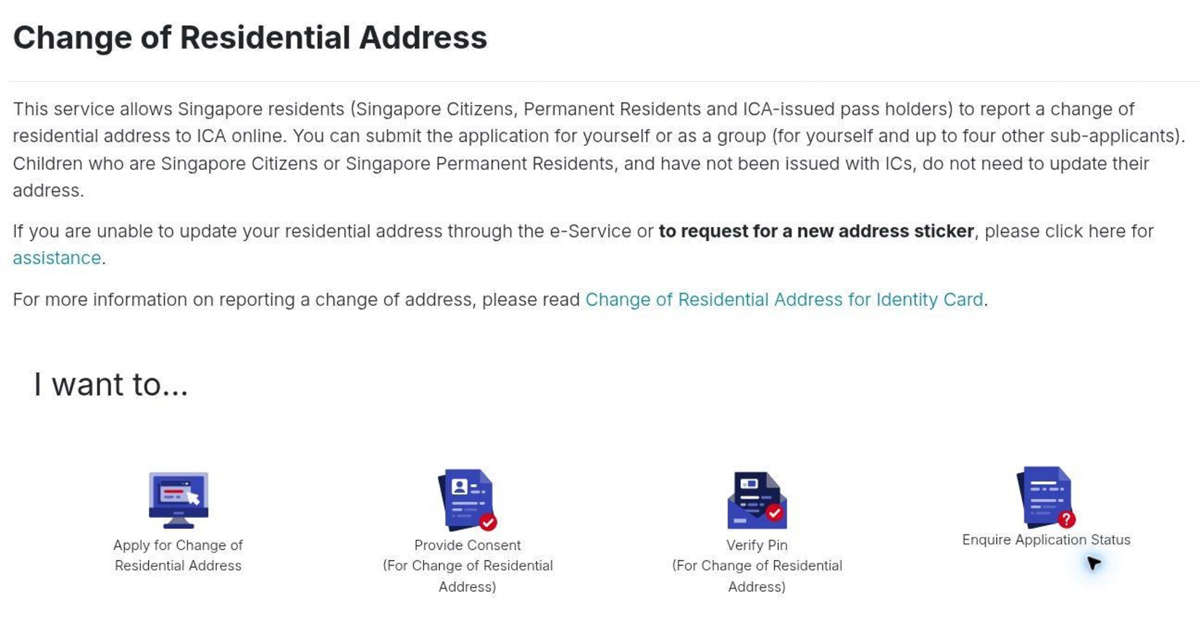
ICA’s public service page separates the application, consent, PIN verification, and status functions.
Step 2: Submit the New Address
Enter your actual residential address accurately. For a group application, follow the consent requirements for the other applicants.
Step 3: Complete the Mailed PIN Verification
ICA sends a PIN mailer to the new address. Return to the service and use “Verify Pin” to complete verification. Submission alone does not complete this step.
After a successful standalone address update, affix the mailed address sticker to the back of your IC. If the address change accompanies a replacement or re-registration application, ICA processes the card application after PIN verification and issues the new card with the new address.
Review separate address records held by your bank, insurer or business contacts rather than assuming every organisation has been updated.
Can You Use the Singpass Digital IC?

The Digital IC displays identity details in the Singpass app and is accepted for many in-person government services. Businesses are encouraged to accept it, although acceptance depends on the transaction and any applicable requirements.
It does not remove the obligation to maintain and replace your physical NRIC. Certain transactions, including specified ICA formalities, still require the physical card. Confirm what to bring before attending an appointment.
Present the live Digital IC in the app when requested. Its animated security feature helps distinguish it from a captured image. A screenshot should not be treated as equivalent to viewing the live credential.
Singpass guidance also states that the Digital IC is not intended to be screen-captured for routine record-keeping. Organisations should use an appropriate data collection method, such as Myinfo or Singpass Verify with consent, where available. Limited regulated exceptions exist, so a request from a bank should be assessed in its specific context.
NRIC Data Protection Rules in 2026
When is Collection Permitted?
Under the PDPC’s published guidance, private organisations may collect, use or disclose NRIC numbers or copies where 法律要求, where a PDPA exception applies, or where necessary to establish or verify identity to a high degree of accuracy. Applicable notification and consent requirements still matter.
评估 whether the transaction needs NRIC information and whether taking a full copy collects more data than necessary. Organisations should generally not retain the physical card unless required by law.
For employment, distinguish statutory employee records from a preliminary job application. The legal need to keep an employee’s identity details does not mean every applicant must provide an NRIC copy at the first contact.
Stop Using NRIC Numbers as Passwords
Private organisations must phase out NRIC-based authentication by 31 December 2026. PDPC will step up enforcement from 1 January 2027. This includes full or partial NRIC numbers used as passwords, including combinations with readily available details such as birth dates.
Review account logins, document passwords, call-centre checks and recovery processes. Where authentication is needed, use an appropriate secure method rather than making NRIC information the secret that unlocks access.
Protect Records Throughout Their Use
Restrict access to staff who need the information, use secure collection channels and set a justified retention period. Remove records when they no longer serve the relevant purpose or are needed for business or legal reasons.
Map where identity details appear across forms, HR systems, client files, and outsourced services. This makes it easier to correct unnecessary collection and inconsistent retention practices. InCorp’s personal data protection services can help businesses review their policies and handling practices.
Penalties for NRIC Misuse and Non-Compliance
NRIC obligations are legal requirements, and penalties depend on the particular offence.
For example, ICA states that failing to report a residential address change can result in a fine of up to S$5,000, imprisonment of up to five years, or both. These are maximum penalties for that offence, not an automatic charge for an address correction.
False particulars, identity misuse, and fraudulent documents can involve separate offences. Supply accurate information and contact ICA promptly if a record needs correction.
Managing Identity Requirements When Relocating to Singapore
The Singapore NRIC is issued to Singapore citizens and permanent residents. Foreigners working, studying or residing in Singapore are generally issued a Foreign Identification Number (FIN) instead. As NRIC and FIN requirements depend on a person’s residency and immigration status, foreign founders and employees should check which identification document applies to their circumstances.
InCorp’s Singapore 移民服务 can support eligible clients with relevant immigration applications. ICA remains responsible for NRIC issuance and its official card procedures.
FAQs about NRIC Singapore
Do permanent residents receive an NRIC?
- Yes. Permanent residents receive a blue NRIC, while Singapore citizens receive a pink card. A long-term pass holder who has not obtained permanent residence generally uses a FIN rather than an NRIC number.
Is an NRIC the same as a FIN?
- No. They identify different categories of individuals. Use the identifier assigned to you and select the matching document type when completing a form.
Can foreigners obtain an NRIC by registering a company?
- No. Incorporation and immigration status are separate. A company’s UEN identifies the business; it does not give its foreign shareholders Singapore citizenship or permanent residence.
Find out how we can help with immigration matters
关于作者