Post-Event Webinar Summary
As ESG expectations continue to rise across regulators, financiers, investors and supply chains, sustainability is no longer only a compliance matter. It is becoming a strategic business priority that can shape cost management, risk resilience, access to capital and long-term competitiveness.
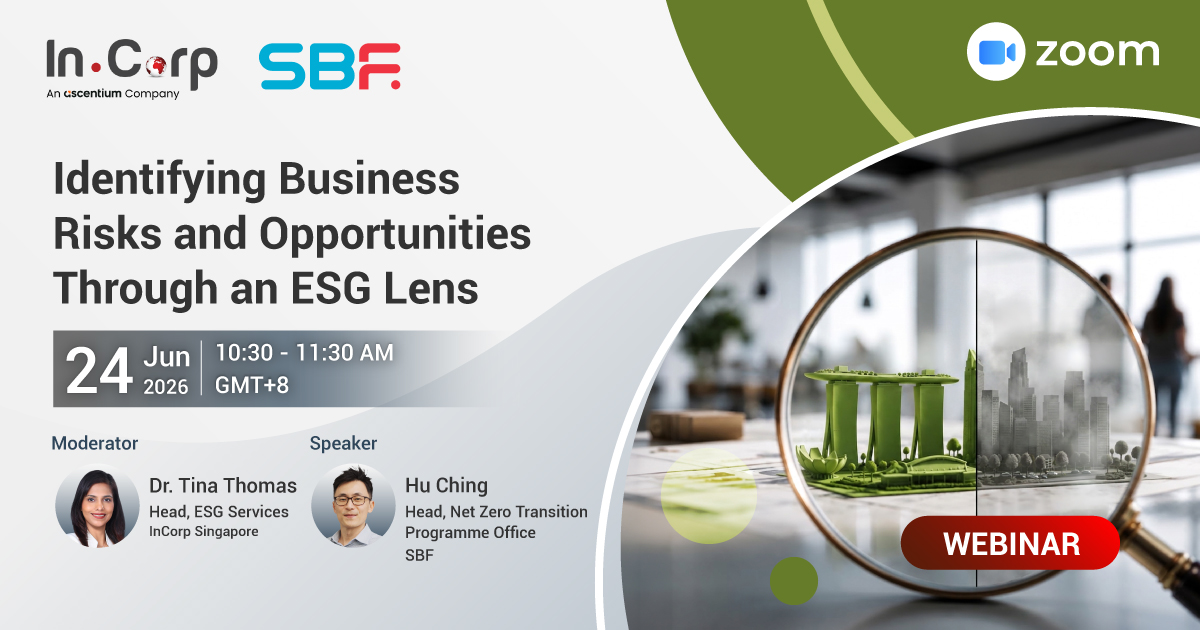
InCorp Singapore, an Ascentium company, hosted the webinar Identifying Business Risks and Opportunities Through an ESG Lens, featuring Dr Tina Thomas, Head of ESG Services at InCorp Singapore, and Hu Ching, Head, Net Zero Transition Programme Office at the Singapore Business Federation.
The session explored how companies can move from ESG reporting to ESG decision-making, with practical perspectives on climate risk, sustainability disclosure, emissions management, supplier expectations, financing considerations and boardroom readiness..
Watch the Webinar On Demand
Missed the live session? Watch the full webinar recording below to hear directly from Dr. Tina Thomas and Hu Ching on how ESG is reshaping business strategy, risk management and competitiveness.
5 main areas covered in this session:
- ESG has moved beyond compliance
- Climate risk is becoming financial risk
- ESG data needs stronger governance and assurance readiness
- Scope 3 and supplier expectations are becoming urgent
- Green 100 and TR149 can help businesses move from intention to action
-
ESG has moved beyond compliance
The session opened with a clear message: ESG is no longer confined to sustainability reports or regulatory submissions. It is increasingly connected to business resilience, profitability, access to capital and market competitiveness.
For boards and management teams, the shift is from asking whether ESG matters to understanding how prepared the organisation is when ESG risks begin affecting commercial outcomes.
-
Climate risk is becoming financial risk
Dr Tina Thomas highlighted how climate-related risks are moving closer to the balance sheet. Extreme weather, heat stress, flooding, rising insurance premiums, supply-chain disruption and asset exposure are no longer distant concerns.
As banks, investors and regulators strengthen climate-risk expectations, companies with credible transition plans and reliable ESG data may be better positioned to manage financing costs and long-term business risk.
-
ESG data needs stronger governance and assurance readiness
The discussion covered the growing importance of structured and credible ESG data, particularly as ISSB-aligned reporting gains momentum.
Companies are expected to treat sustainability data with greater discipline, similar to financial reporting. This includes clearer ownership, stronger internal controls, better documentation and readiness for future assurance requirements.
-
Scope 3 and supplier expectations are becoming urgent
Hu Ching shared practical perspectives on how sustainability requirements are moving through supply chains. Larger organisations are increasingly asking suppliers for emissions data, ESG metrics and evidence of sustainability action.
For SMEs, regional businesses and growth companies, this creates both pressure and opportunity. Suppliers that can provide credible ESG and carbon data may be better positioned for tenders, preferred supplier lists and future financing opportunities.
-
Green 100 and TR149 can help businesses move from intention to action
The webinar also discussed Green 100 and Technical Reference 149, or TR149, as part of Singapore’s effort to scale sustainable procurement.
These initiatives aim to provide businesses with a more consistent framework across areas such as carbon, water, waste and circularity. For suppliers, this may help reduce duplicative buyer-by-buyer requirements and create a clearer path to demonstrate sustainability progress.
Download the ESG Briefing Report
"*" indicates required fields
About the Author
-

Head of ESG
InCorp SingaporeDr. Tina Thomas is the Head of ESG at InCorp Singapore, where she advises boards across the Asia-Pacific on leveraging ESG principles for risk mitigation and long-term value creation. With over 15 years in the oil and gas sector, she helps organizations integrate ESG into their strategies while delivering measurable business outcomes and improving investor confidence. Tina holds a PhD in Strategy and International Business from Warwick Business School, an MBA from London Business School, a postgraduate qualification in Economics from the London School of Economics, and a BTech in Electrical Engineering from the Indian Institute of Technology.
-

Head, Net Zero Transition Programme Office
Singapore Business Federation (SBF)Mr. Hu Ching heads the Singapore Business Federation’s Net Zero Transition Programme Office. His team spearheads initiatives to support enterprises with their sustainability journey, such as the Council for a Competitive Climate Transition (C3T), Singapore Emission Factors Registry, NetZeroHub.SG, Cost and Carbon Reduction Programme, Queen Bee Enabled Sustainability Transition (QUEST) Programme, sustainability advisory, and policy advocacy.
Hu Ching marries his passion for climate action and education by serving as adjunct trainer for sustainability-related executive education programmes. He was previously Climate Regulations and Reporting Specialist at climate tech startup Terrascope and launched the Singapore office of global corporate sustainability ratings agency EcoVadis. Hu Ching has a deep interest in public policy, having started his career with the Singapore Government.