
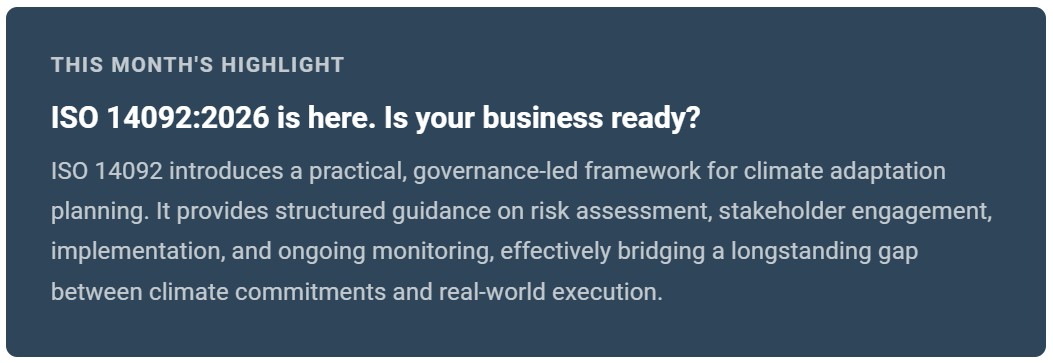
The launch of ISO 14092:2026 marks an important shift in the global ESG landscape, one that moves climate action from ambition to structured execution.
For years, corporates have focused heavily on decarbonisation, net zero targets, emissions disclosures, and transition strategies. While these remain critical, the conversation is now expanding rapidly toward climate adaptation: how organisations prepare for and respond to the physical impacts of climate change.
Why this matters now
Climate risks are no longer theoretical. Flooding, extreme heat, water stress, and supply chain disruptions are already impacting operations across sectors. Importantly, adaptation is no longer viewed as a “nice to have” or a public sector responsibility; it is becoming a core governance expectation.
The standard also signals a broader shift: access to climate finance and investor confidence are increasingly tied to credible, structured adaptation planning.
What this means for corporates
- Climate risk management is moving from disclosure to accountability Frameworks such as ISSB and TCFD have pushed companies to disclose risks. ISO 14092 takes this further; it expects organisations to demonstrate how those risks are being actively managed, prioritised, and mitigated over time.
- Physical risk is now as critical as transition risk. Many companies have focused on carbon reduction, but physical risks, asset damage, operational downtime, and workforce safety are becoming equally material. Corporates will need to integrate site-specific and supply chain-level risk assessments into their strategy.
- Governance will be scrutinised. Adaptation is framed as an ongoing governance responsibility, not a one-off exercise. Boards and management teams will need to show clear ownership, decision-making structures, and accountability mechanisms for climate resilience.
- Data, monitoring, and evidence will be key. The emphasis on monitoring and continuous improvement means companies must move beyond narrative reporting. There will be increasing demand for data-driven evidence, KPIs, and audit-ready processes, particularly as assurance expectations rise.
- Link to capital and financing will strengthen. As climate finance mechanisms evolve, companies with structured adaptation plans will be better positioned to access green financing, resilience-linked funding, and investor capital. Conversely, weak or unstructured approaches may increase financing risk.
- Supply chains will come under pressure. Large corporates will increasingly require their suppliers to demonstrate resilience. This creates a cascading effect; adaptation readiness will become a competitive differentiator across value chains.
The strategic shift: from compliance to resilience
What ISO 14092 ultimately signals is a deeper transition in ESG, from compliance-driven reporting to resilience-driven strategy.
For corporates, this is not just about managing downside risk. Organisations that proactively embed adaptation into their strategy can enhance operational resilience, strengthen stakeholder trust, and position themselves more competitively in a climate-constrained future.
How we support
At InCorp, we work with clients across Singapore and the wider Asia-Pacific region to move from ESG ambition to execution. This includes:
- Climate risk and vulnerability assessments
- Adaptation and resilience strategy development
- Integration with ISSB / TCFD disclosures
- Data systems, monitoring, and ESG assurance readiness
As the ESG landscape continues to evolve, the question is no longer whether to act—but how quickly organisations can operationalise climate resilience in a structured, credible way.
Discover practical ESG solutions for your business
About the Author