Implementing Environmental, Social, and Governance (ESG) initiatives is a pivotal step for charities and Institutions of a Public Character (IPC) looking to transform awareness into meaningful action. By embedding
ESG into their operations, charities can align their values with actionable strategies that resonate with stakeholders and enhance their societal contributions.
However, starting on the process can be daunting for charities with no prior experience in doing so. This blog, the first of a 2-part series, aims to simplify the implementation process by breaking down the different aspects that charities can start with to help them better navigate their journey.
It will touch on several methodologies, such as establishing a governance structure, delegating roles and responsibilities, and more, before sharing how our ESG service can help. Ultimately, we aim to furnish charities with essential information to guide their way.
Integrating ESG into Charity Board Agenda
Charity boards must recognise that sustainability is a critical component of its long-term success. It needs to be included in its core strategies and board agenda.
Charities may also need to assess their governance structures, especially sustainability-related decision-making processes, to bolster their ESG implementation.
Related Read: Driving Sustainable Change Through ESG for Charities and IPCs in Singapore
Establishing a Governance Structure
Setting Up an ESG Sub-committee
Strong governance structure is vital to ensuring governance efficiency. Charities can modify their current governance structure to incorporate ESG governance and supervision. Since every charity is different, we recognise that there is no one-size-fits-all method.
An ESG sub-committee can be established to define charities’ ESG strategy and oversee related initiatives. This sub-committee should encompass management- and board-level members. This is because management is key to oversee the final delivery and practices of ESG.
Determine Core Roles in the Governance Structure
The size of the ESG sub-committee and preferred number of members required to ensure sufficient supervision, management, and implementation of ESG initiatives must be considered.
Members of the sub-committee should perform different roles across service lines and functions to make sure that ESG is successfully implemented throughout the organisation.
Delegating Responsibilities for Overseeing and Managing ESG
Roles and Responsibilities
A set of Terms of Reference is recommended to define and outline these aspects of the ESG sub-committee clearly:
- Purpose and Objectives
- Structure
- Reporting
- Goals
- Roles and Responsibilities
An ESG learning and development plan should be defined to enable the sub-committee and employees to have relevant knowledge and skills to implement and run ESG initiatives effectively. The methodology and guidelines for incorporating considerations of the charity’s impact into present decision-making processes should also be defined.
Decision-Making
Decision-making authority within the ESG sub-committee should be appointed, as well as establishing formal decision-making processes. Boards should be made accountable for and should spearhead the charity’s transformation campaign. ESG metrics can be incorporated when evaluating members’ performance and incentives.
Initiating Systems and Procedures
A sub-committee charter that has its mission, goals, structures, and procedures should be established. Communication mediums and regular meetings with the charity board and management should be established.
Integrating ESG into the Enterprise Risk Management (ERM) Framework
Although the concept of ESG is a new area of focus for charities, it can be integrated into their existing frameworks and processes instead of starting from ground up. This will also help charities create practical steps to achieve their goals alongside effective monitoring and reporting.
The table below shows how the ESG framework can integrate into the ERM framework:
| ERM Component |
ESG Consideration |
| Risk Governance |
- Boost the terms of reference of present board committees overseeing ESG issues
- Detail the roles and responsibilities on ESG issues for each function across the charity
|
| Risk Strategy and Appetite |
- Think about ESG-related risks while creating business objectives at varying levels that align with and support the charity’s strategies
|
| Risk Assessment and Measurement |
- Assess material issues determined in the ESG report
- Determine material ESG risks as part of the risk management from current ERM processes and various types of analysis
|
| Risk Culture |
- Strengthen ESG risk awareness culture by incorporating ESG elements into the charity’s mission, core values, and objectives
|
| Risk Management and Monitoring |
- Establish specific KPIs on ESG targets, including environmental and social risks
|
| Risk Reporting and Insights |
- Use existing ESG reporting mechanisms to set the frequency and form of reporting on ESG performance to the board or committees
- Boost the disclosure of ESG risks and discussion on how ESG issues are related to the business
|
| Technology and Data |
- Examine current KPI tools for ERM to further allow ESG KPI reporting with regards to data availability and reliability
- Keep, manage, and report real-time risk data on KPIs, including ESG
|
Defining ESG Strategy
Having a well-defined ESG strategy can support charities in reaching the ESG goals. They are encouraged to create an ESG strategy that is meticulously planned and consulted to review their present ESG status, define future ambitions, and determine the required actions to take.
These key steps can be considered when creating the strategy:
| Step |
What it Means |
| Step 1: Identifying Core ESG Topics |
- Engaging stakeholders to understand and discern the most vital ESG topics affecting the organisation that are prioritised by stakeholders
|
| Step 2: Assessing Present State and Exploring Possible Initiatives |
- Understanding the current ESG maturity and exploring initiatives, keeping with its ESG goals
- Discerning and prioritising possible ESG initiatives that can bridge gaps between the charity’s present state and ambition level
|
| Step 3: Establishing the Level of Ambition |
- Determine where the charity wants to be and what it wants to achieve to shape parameters for an ESG strategy
|
Identifying Core ESG Topics
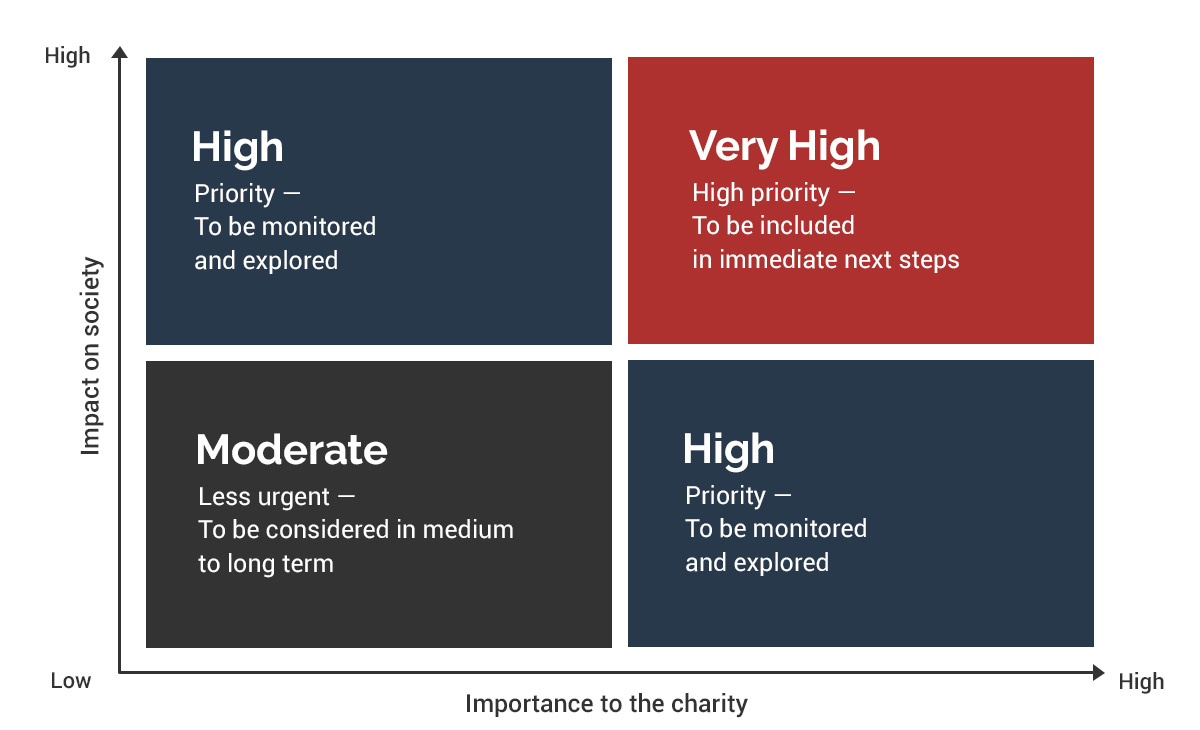
Charities should determine ESG topics that are most important to them and their stakeholders by reviewing internal operations and having discussions with stakeholders. Engaging with stakeholders using different methods on various ESG issues can help charities better prioritise and align their efforts with the concerns of the groups they serve.
The stakeholder engagement process can happen over a few stages, which are:
- Stakeholder Identification
- Identification of Possible ESG Issues
- Stakeholder Engagement
- Prioritisation of ESG Issues
An assessment matrix may be useful to prioritise ESG topics, with an example being:
Assessing Present State and Exploring Possible Initiatives
Following that, charities should review their current ESG status and establish clear objectives. This review can enable charities to measure their current ESG performance and determine present ESG performance and identify required actions to achieve their desired future state.
After the core ESG topics are identified, charities can then proceed to create and plan initiatives to boost progress. This includes organising and carrying out specific actions and programmes.
Establishing the Level of Ambition
After the identification of core ESG topics, understanding the current state and looking into different initiatives to drive progress, charities should assess their ESG ambition levels.
Some key considerations include knowing who the key stakeholders are, whether the charity has the resources and capabilities required to achieve their goals, and the ESG topics that are of immediate priority.
Some examples of ESG goals and initiatives that charities can have are:
| Environmental Goals |
Social Goals |
Governance Goals |
| The commitment to resource conservation |
The commitment to community engagement |
The commitment to data protection |
| Reducing carbon footprint |
The dedication to socially responsible business |
The commitment to board diversity |
| Forging green partnerships with suppliers and partners |
Encouraging employee well-being |
The dedication to ethical fundraising |
Driving ESG Initiatives
Following the establishment of charities’ ESG strategy comes the implementation of ESG initiatives. While charities are expected to have robust experience in the social aspect of ESG, they may not be as familiar in the environmental facet.
Decarbonisation
One potential environmental initiative that charities can undertake is decarbonisation. Decarbonisation refers to the reduction of greenhouse gas (GHG) emissions. This can be achieved through a variety of methods, such as:
- Boosting energy efficiency
- Switching to low-carbon energy sources
- Using other environmentally friendly practices
A charity’s carbon footprint can be referred to as its total GHG emissions. The Greenhouse Gas Protocol creates comprehensive international standardised frameworks to measure and manage GHG emissions across public and private sector operations, mitigation actions and value chains.
We will use this protocol as a reference to provide additional information of how charities can begin their decarbonisation efforts.
How to Start Decarbonisation
Charities must measure their carbon footprint before they begin their decarbonisation efforts. They can first quantify their Scope 1 and Scope 2 emissions before progressing to Scope 3 after. Scope 3 emissions usually make up the biggest portion of a charity’s carbon footprint.
Depending on its activities, a charity’s bulk of Scope 3 emissions may be due to purchased goods and services, capital goods, and investments.
We look at a brief definition of Scope 1, 2, and 3 emissions:
| Scope 1 |
Scope 2 |
Scope 3 |
| Direct Emissions:
Sources owned or controlled by the entity, such as stationary and mobile combustions
|
Indirect Emissions:
Sources owned or controlled by the entity, such as emissions from purchased electricity
|
Indirect Emissions:
Sources not owned or controlled by the entity but are part of its upstream or downstream value chain, such as the usage of products donated to charities
|
Reducing a Charity’s Carbon Footprint
Charities can start tackling their carbon footprint by reducing operational emissions through strategies to drive sustainable practices. Addressing Scope 2 emissions is more likely to be straightforward because of the nature of their operations.
For example, charities can invest in energy efficient upgrades, renewable energy, or reduce energy consumption.
On the other hand, for Scope 3 emissions, charities with advanced ESG maturity should review their entire value chain emissions to determine areas to be reduced through philanthropic actions.
One example is considering conducting detailed research and supply chain ESG due diligence on product suppliers, distribution channels, and products purchased regarding donations.
Delivering a Successful ESG Strategy
Charities should establish intermediate goals, define roles, provide training, and implement the prepared actions routinely to ensure the ESG strategy’s success.
Some core considerations charities should have include:
- Aligning realistic goals with the result using milestones
- Defining roles and responsibilities by identifying suitable members and creating a project management team
- Building ESG capacity through targeted training
- Engaging key stakeholders
- Monitoring achievements and communicating results through sustainability reports
Communicating ESG Performance
Charities are urged to disclose ESG-related information to convey their ESG practices and efforts to donors, employees, beneficiaries, and wider communities.
How to Communicate ESG Performance
Charities can communicate ESG performance through:
| Sustainability Reports and Annual Reports |
Policies and Frameworks |
Official Websites, Media, and News |
| Charities can start by creating an ESG section in their annual reports. They can create sustainability reports to display detailed information on ESG performance after they have sufficient ESG maturity. |
Charities can create and disclose ESG-related policies and frameworks that show good quality of governance. |
The most flexible method of disclosure is reporting via the charity’s website, social platforms, and media. This provides stakeholders with regular and active updates on their initiatives. |
Determining What to Communicate
Reporting can provide charities with a way for charities to communicate their contributions to sustainable growth. Here is a simple framework to guide charities in deciding on what to communicate to their stakeholders:
| Sustainability Reports and Annual Reports |
Policies and Frameworks |
| ESG Governance |
- Governance structure
- Roles and responsibilities
- Sustainability management
- Composition of ESG committees
|
| ESG Topics |
- Important and relevant topics to charities and their stakeholders
- Stakeholder engagement process and outcomes
- Reasons why chosen topics are relevant and relevant to charities and their stakeholders
|
| ESG Strategy |
- Communicating plans to operate sustainably and drive sustainable growth
- How charities manage their impacts on society and the environment
|
| ESG Policies |
- Existing policies that support ESG strategy
|
| ESG Initiatives |
- Existing or intended initiatives to implement ESG strategy
- Progress and results of these initiatives where possible
|
Adjusting to Recognised Sustainability Reporting Frameworks
Charities that are more advanced in terms of ESG maturity can think about using a recognised sustainability reporting framework when preparing their ESG disclosures.
There are some internationally recognised ESG reporting frameworks and standards today, such as the International Financial Reporting Standards (IFRS) Sustainability Disclosure Standards, IFRS S1 and IFRS S2.
Considering the non-profit nature of charities, they can consider using the Global Reporting Initiative (GRI) Standards. The GRI allows an organisation to either report its key ESG impacts or focus on certain issues and appeal to a wide range of stakeholders.
| Facet of GRI Standards |
Details |
| Objective |
The GRI Standards allow organisations to publicly report |
| Structure |
The GRI Standards are a modular system made of 3 series of Standards:
- The GRI Universal Standards
- The GRI Sector Standards
- The GRI Topic Standards
|
| Reporting Process |
There are 3 key steps in the reporting process in accordance with the GRI Standards:
- Identifying and assessing impacts
- Determining material topics
- Reporting disclosures
|
| Disclosure Format |
Reports using the GRI Standards can be published in different formats and made available across at least 1 location. Reports must have a GRI content index that makes reported information traceable and enhances its trustworthiness and transparency. |
It can be used for all organisations regardless of size, sector, or location. While its use is encouraged, it is not compulsory. Hence, charities should consider how applicable the framework is to the charity and its operational model and its usability while meeting the objectives of the charity’s stakeholders.
Charities should follow GRI reporting principles to achieve the quality and precise presentation of information. This will enable users to make informed assessments of the charity’s impact and its role in sustainable development.
How Can InCorp Help?
By adopting ESG principles, charities can unlock opportunities such as attracting new funding sources, retaining skilled talent, and improving operational efficiency. ESG practices also enable them to engage with stakeholders in more innovative ways, strengthening transparency and accountability. This, in turn, builds greater trust with donors, beneficiaries, and the wider community.
Conversely, overlooking ESG initiatives can lead to risks, including a decline in stakeholder confidence and missed chances for funding and resource optimisation. Embedding ESG principles into their operations enables charities to actively support sustainable development while driving meaningful social impact for the communities they serve.
At InCorp, we specialise in providing expert guidance to charities seeking to enhance their reporting practices. Our team can help you with sustainability reporting to align with the GRI standards, ensuring accurate and transparent reporting that resonates with stakeholders and supports your mission.
From setting targets to align your charity’s goals and outcomes to measuring the performance of ESG topics, we are committed to helping you achieve compliance and improve your impact narrative. With years of experience in sustainability and corporate reporting, we aim to empower charities with the tools and knowledge needed to meet their goals effectively.
Contact us to get started today!
FAQs about Charities and IPCs in Singapore
- Charities and IPCs in Singapore are guided by the revised Code of Governance for Charities and IPCs (2023).
- Examples include volunteer development, promoting diversity and inclusion, and committing to transparency and accountability.
- Yes, philanthropy is highlighted as a key component of how charities and non-profits can manage their relationships with stakeholders and contribute to societal well-being.
- Some ESG practices in Singapore include mandatory climate reporting for required companies, as well as the implementation of internationally accredited frameworks.
- Yes, it is mandatory for all listed companies to disclose their sustainability practices.
- Some major ESG standards include the IFRS Sustainability Disclosure Standards and Global Reporting Initiative (GRI) Standards.
Engage Us
Consult professional ESG experts to facilitate smooth ESG implementation!
About the Author
Ruby Rouben
Ruby brings over 16 years of extensive experience in the audit field to the role, the majority of which was spent leading the internal audit and risk advisory engagements across publicly listed companies, institutions of higher learning, MNCs, statutory boards, ministries, and more.
In recent years, Ruby has focused on advancing sustainability consultancy services, leading internal evaluations of the sustainability reporting processes for publicly listed companies. This shift underscores Ruby's commitment to enhancing corporate responsibility and environmental stewardship in the business landscape.
More on Business Blogs