If you are running a business in Singapore, you need to report your income to the Inland Revenue Authority of Singapore (IRAS) by filing your tax return forms C-S or C.
These forms help declare the annual income of companies and must be duly completed and submitted within the specified due dates. It’s crucial to emphasise that even if a company is experiencing losses, there is still an obligation to submit a corporate tax return.
What is Form C-S/Form C-S (Lite)?
Form C-S and Form C-S (Lite) were specially introduced by the Singapore government to make filing tax forms cost-effective in terms of time and money and to make the process more simplified. They will help small companies report their annual income to IRAS. They can be submitted via e-filing, which is easier.
Necessary Documents for Filing of Form C-S
Companies filing Form C-S generally do not need to submit their financial statements and tax computation with the return. However, they must prepare and retain these documents and provide them to IRAS if requested. The due date for filing Form C-S is 30 November 2026, but companies or tax agents using the Seamless Filing From Software (SFFS) system have an extended deadline of 15 December 2026. Even then, documents like tax adjustments, tax computations and financial accounts are to be prepared and kept just in case the IRAS makes a request to submit them.
What is Form C?
Form C is the full Corporate Income Tax Return. Companies that do not qualify for Form C-S/Form C-S (Lite) generally file Form C and submit the required financial statements, tax computation and supporting documents. E-filing is due by 30 November, with an extension to 15 December for those using the Seamless Filing from Software (SFFS) system.
e-Filing of Tax Form C-S
E-filing of tax Form C-S is convenient as it helps in the auto-computation of payable tax and includes the option of saving a draft until the form is ready to be submitted.
You also receive instant acknowledgement once the tax is successfully filed.
Criteria for Filing Form C-S
- The company should be incorporated in Singapore
- To file Form C-S, the company must have an annual revenue of $5 million or less. For even simpler filing, companies with revenue of $200,000 or below can opt to file Form C-S (Lite).
- Income derived taxable at 17%
You are not eligible to file tax returns if you claim:
- Carry back of current year capital allowance/losses
- Group relief
- Investment allowance
- Foreign tax credit or tax deducted at source
Tips for e-Filing Form C-S
Before filing, ensure that you are authorised by the company as an Approver for “Corporate Tax (Filing and Applications)” in Corppass. You will also need your Singpass and the company’s UEN/entity ID. The SingPass system remains the authentication method, but the IRAS PIN is now replaced by Corppass for company-related approvals. The person filing must be authorised as an Approver for the relevant corporate tax service.
You can use InCorp’s free Corporate Tax Calculator to compute your taxes in preparation for e-filing.
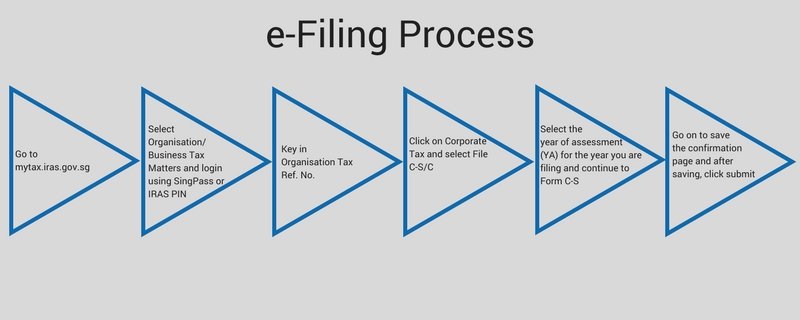
To begin e-Filing:
- Go to mytax.iras.gov.sg
- Select Organisation/Business Tax Matters and login using SingPass or IRAS PIN
- Key in Organisation Tax Ref. No.
- Click on Corporate Tax and select File C-S/C
- Select the year of assessment (YA) for the year you are filing and continue to Form C-S
- Go on to save the confirmation page and after saving, click submit.
If you leave the filing page idle for more than 20 minutes, it will logout and you must log in from the start. If you are unable to complete it at one go, save the current session and continue later.
Now, you can confidently file your Income Tax Returns via Form C-S. You can also take the help of corporate tax consultants who will make the job easier for you by preparing corporate tax computation, director’s reports, and getting ready corporate tax forms.
Frequently Asked Questions
When to file corporate income tax in Singapore?
- In Singapore, companies must file their Estimated Chargeable Income (ECI) within 3 months from the end of their financial year. The Corporate Income Tax Return (Form C or Form C-S) must be filed annually by 30 November of the year following the financial year end.
When to submit IRAS 2026?
- For the Year of Assessment (YA) 2026, companies in Singapore must submit their Estimated Chargeable Income (ECI) within 3 months from the end of their financial year. The Corporate Income Tax Return (Form C-S/C) must be filed by 30 November 2026.
How to pay corporate tax in Singapore?
- To pay corporate tax in Singapore, companies must first file the Estimated Chargeable Income (ECI) within three months after the financial year-end, unless exempted. The actual Corporate Income Tax Return (Form C or Form C-S) is then filed annually with the Inland Revenue Authority of Singapore (IRAS), typically by 30 November. After assessment, IRAS issues a Notice of Assessment (NOA), and companies must pay the tax within one month of the NOA date. Payment can be made via electronic methods such as GIRO, internet banking, or other approved payment channels.
Need help filing your Singapore corporate tax returns?
About the Author