In Singapore’s business environment, handling personal data is a daily activity. Yet, this routine task comes with significant legal duties. The Personal Data Protection Act (PDPA) sets the rules for how organisations must manage personal information, establishing a framework built on trust and responsibility. For any business, understanding these rules is not just about legal compliance, it is fundamental to maintaining customer confidence and a strong reputation.
For business owners and management teams, navigating the legal intricacies of the PDPA can feel daunting. Yet, compliance is not just about avoiding penalties; it is about building trust with your customers and employees. When individuals know their data is safe with you, they are more likely to engage with your brand.
The PDPA outlines a set of obligations that govern the entire data lifecycle, from collection to disposal. Recent amendments have expanded these duties, bringing the total to 11 key obligations that every organisation must follow. This guide provides a clear, structured overview of each obligation, offering the clarity needed to navigate data protection with confidence. By mastering these principles, you can transform compliance from a challenge into a strategic asset.
Key Takeaways
- Prioritise PDPA compliance to build client trust and gain a competitive advantage.
- Appoint a Data Protection Officer (DPO) to demonstrate accountability and oversee compliance.
- Implement robust policies for the entire data lifecycle, from collection to secure disposal.
- Establish clear procedures for notifying the PDPC and individuals in the event of a data breach.
- Integrate data protection into your business strategy to mitigate risks and enhance your reputation.
The Foundation of Data Protection
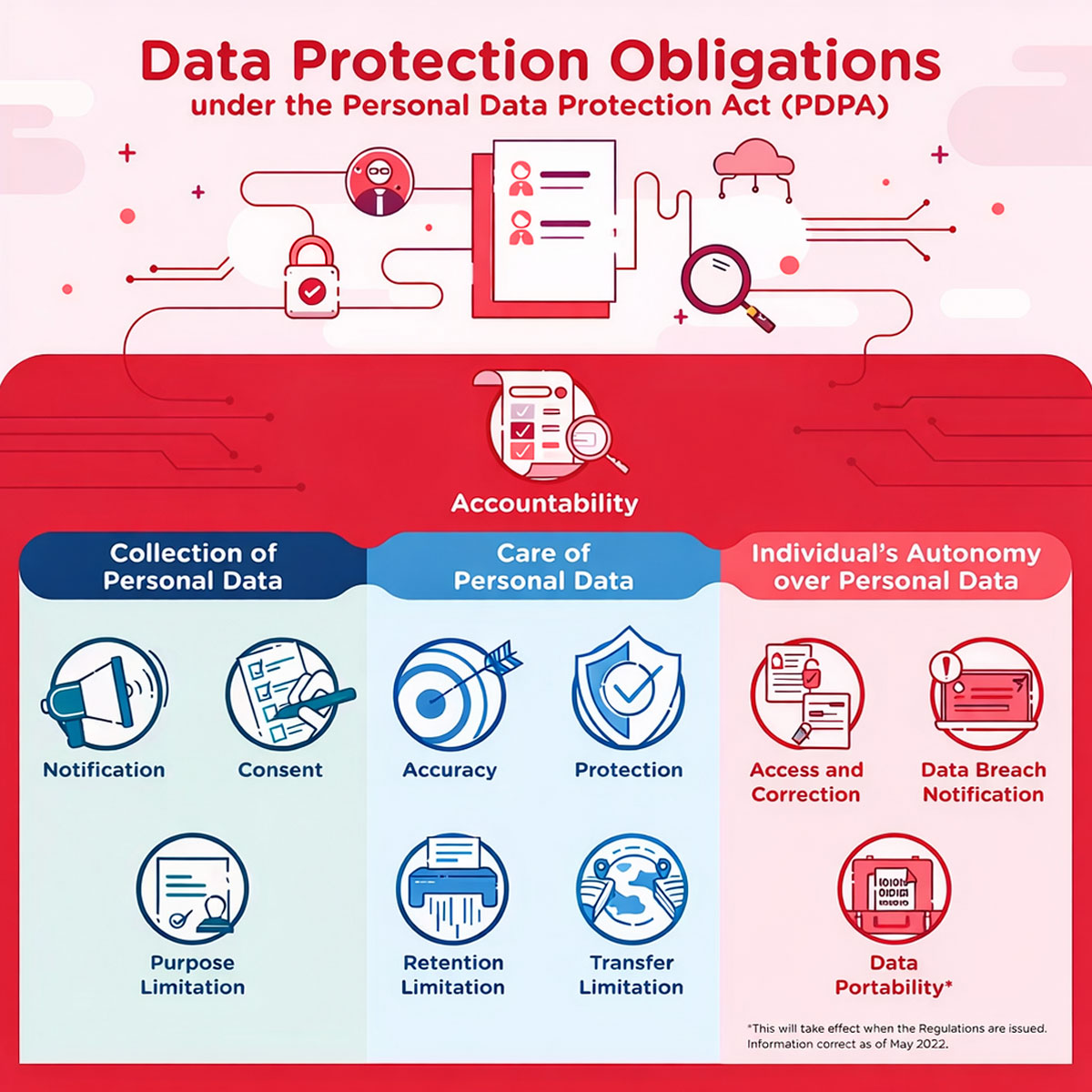
The PDPA is administered by the Personal Data Protection Commission (PDPC). Its primary goal is to govern the collection, use, and disclosure of personal data by organisations in a way that recognises both the right of individuals to protect their data and the need of organisations to collect it for legitimate purposes.
Compliance starts with understanding the “rules of the road.” These rules are defined as the Data Protection Obligations. While recent amendments have introduced new requirements (such as Data Breach Notification), the core framework rests on these nine fundamental obligations.
1. Accountability Obligation
The Accountability Obligation is the cornerstone of the PDPA framework. It shifts the mindset from “checking boxes” to demonstrating active responsibility for the personal data in your possession or control.
What it entails:
Your organisation must undertake measures to ensure it meets its obligations under the PDPA. This is not a passive requirement; it requires tangible evidence of compliance.
Key requirements for businesses:
- Appoint a Data Protection Officer (DPO): You must designate at least one individual to oversee data protection responsibilities. Their business contact information must be publicly available so the public can reach them with inquiries or complaints.
- Develop Policies: You need to implement data protection policies and practices.
- Transparency: These policies, along with your complaint handling processes, must be made available to the public upon request.
By fulfilling this obligation, you signal to stakeholders that data privacy is a boardroom priority.
Related Read: Guide to Choosing a Data Protection Officer for Your Company in Singapore
2. Notification Obligation
Transparency is key to trust. Individuals have a right to know why you need their information before they hand it over.
What it entails:
You must notify individuals of the specific purposes for which your organisation intends to collect, use, or disclose their personal data. This notification must occur strictly on or before the collection of data.
Key requirements for businesses:
- Clear Privacy Notices: Ensure your website, forms, and contracts contain clear privacy notices.
- Understandable Language: Avoid legal jargon. The notification should be easily understood by a reasonable person.
- New Purposes: If you intend to use existing data for a new purpose different from what was originally notified, you must notify the individual again before using the data.
3. Consent Obligation
Notification alone is not enough; you generally need the individual’s permission.
What it entails:
You are prohibited from collecting, using, or disclosing personal data unless the individual has given their consent for those specific purposes.
Key requirements for businesses:
- Opt-In Mechanisms: Use active opt-in methods (like ticking a box) rather than pre-ticked boxes.
- Deemed Consent: In specific situations, consent may be deemed given if the individual voluntarily provides data for an obvious purpose (e.g., providing a shipping address to receive a parcel).
- Withdrawal of Consent: You must allow individuals to withdraw their consent at any time with reasonable notice. You must also inform them of the likely consequences of this withdrawal (e.g., inability to continue providing a service) and cease processing their data once consent is withdrawn.
4. Purpose Limitation Obligation
This obligation prevents the “hoarding” of data for undefined future uses.
What it entails:
You may only collect, use, or disclose personal data for purposes that a reasonable person would consider appropriate under the circumstances. Furthermore, you must stick to the purposes for which the individual has given consent.
Key requirements for businesses:
- Reasonableness Test: Ask yourself if the data collection is truly necessary. For example, requiring a full NRIC number to sign up for a simple retail loyalty program is likely unreasonable.
- No Over-Collection: You cannot require an individual to consent to the collection of personal data beyond what is reasonable to provide a product or service. You cannot hold a service “hostage” in exchange for unnecessary data.
5. Accuracy Obligation
Decisions made based on incorrect data can harm individuals. This obligation ensures that the data you rely on is correct.
What it entails:
Organisations must make a reasonable effort to ensure that personal data collected is accurate and complete.
Key requirements for businesses:
- Verification: This is critical if the data is likely to be used to make a decision that affects the individual (such as a credit assessment or employment offer) or if it is likely to be disclosed to another organisation.
- Regular Updates: Implement processes to verify data upon collection and allow individuals to update their details easily.
6. Protection Obligation
Collecting data implies a promise to keep it safe. This is perhaps the most technically demanding obligation.
What it entails:
You must make reasonable security arrangements to protect personal data in your possession or control. This aims to prevent unauthorised access, collection, use, disclosure, copying, modification, disposal, or similar risks.
Key requirements for businesses:
- Cybersecurity Measures: Implement firewalls, encryption, and secure authentication methods for digital data.
- Physical Security: Do not neglect physical files. Keep sensitive documents in locked cabinets and restrict access to authorised personnel only.
- Vendor Management: If you use third-party vendors (intermediaries) to process data, you must ensure they also have adequate security measures in place.
7. Retention Limitation Obligation
Data should not be kept indefinitely “just in case.”
What it entails:
You must cease retaining personal data, or remove the means by which the data can be associated with specific individuals (anonymisation), as soon as it is reasonable to assume that the retention is no longer necessary for legal or business purposes.
Key requirements for businesses:
- Disposal Policies: Establish a data retention policy that defines how long different types of data are kept.
- Proper Destruction: When data expires, it must be disposed of securely. This means shredding physical documents and using secure deletion software for digital files, ensuring they cannot be recovered.
8. Transfer Limitation Obligation
In a globalised economy, data often crosses borders. The PDPA ensures protection travels with the data.
What it entails:
You can only transfer personal data to a country or territory outside Singapore if you ensure that the standard of protection accorded to the data so transferred is comparable to the protection under the PDPA.
Key requirements for businesses:
- Binding Agreements: Typically, this involves signing contracts with the overseas recipient that contain specific data protection clauses.
- Cloud Storage: If you use cloud servers hosted overseas, you must verify that the service provider meets the standard of protection required by Singapore law.
- Exceptions: Transfers are permitted if specific exemptions apply, such as obtaining the individual’s clear consent for the transfer after briefing them on the risks.
9. Access and Correction Obligation
Individuals maintain ownership rights over their data even after they share it with you.
What it entails:
This obligation has two parts. First, upon request, you must provide individuals with access to their personal data and information about how it was used or disclosed within the year prior to the request. Second, you must correct any error or omission in their personal data as soon as practicable.
Key requirements for businesses:
- Access Requests: You must have a process to handle these requests. You may charge a reasonable fee to cover the cost of retrieving the data.
- Correction Requests: If an error is corrected, you generally need to send the corrected data to other organisations to which the personal data was disclosed within the year before the correction.
- Exceptions: There are specific exceptions where you can or must refuse access (e.g., if it reveals personal data about another individual or threatens safety).
10. Data Breach Notification Obligation
This newer obligation mandates action in the event of a data breach. It requires you to assess the breach and notify the relevant parties if it meets certain criteria.
Key requirements for businesses:
- Assess the Breach: If a data breach occurs, you must assess whether it is likely to result in significant harm to the affected individuals or is of a significant scale.
- Notify PDPC and Individuals: If the breach is notifiable, you must inform the PDPC and the affected individuals as soon as practicable, typically within three calendar days.
11. Data Portability Obligation
Also known as the right to data portability, this obligation empowers individuals to have their data transmitted from one organisation to another.
Key requirements for businesses:
- Facilitate Data Transfer: Upon an individual’s request, you must transmit their data in a commonly used, machine-readable format to another organisation.
- Understand the Scope: This obligation applies to user-provided data and user activity data held in an electronic format. Note that this obligation will take effect when the supporting regulations are issued.
Why is Compliance Non-Negotiable?
Fulfilling these 11 PDPA obligations is a continuous process that requires commitment from every level of your organisation. Non-compliance can result in substantial financial penalties and, more importantly, a loss of client trust that can be difficult to regain.
By embedding these principles into your business operations, you create a robust data protection framework. This not only safeguards your organisation from legal risks but also reinforces your brand as a trustworthy partner in an increasingly data-conscious world.
Stay Compliant With Ease
The 11 PDPA obligations form a comprehensive framework for data hygiene. While implementing these measures requires time and resources, it is an investment in the sustainability of your business.
Start by reviewing your current policies against this list. Identify gaps, appoint a capable Data Protection Officer, and ensure your team is trained. Remember that in the digital age, a robust data protection strategy is not just a legal requirement, but a competitive advantage. Find out how to start with our help. Contact our team now!
FAQs about PDPA Obligations
What is the accountability obligation of the PDPA?
- The Accountability Obligation under the PDPA requires organisations to take responsibility for the personal data they handle. This means implementing measures to ensure compliance with the PDPA and being able to demonstrate this compliance when required.
What is the PDPA consent obligation exception?
- The Consent Obligation under the PDPA generally requires organisations to obtain an individual's consent before collecting, using, or disclosing their personal data. However, there are specific exceptions where consent is not required. These exceptions are designed to balance the need for data protection with practical business and operational requirements.
How can InCorp help?
- InCorp can play a pivotal role in helping businesses navigate and comply with the Personal Data Protection Act (PDPA) in Singapore. We provide DPO services and more as an approved DPaaS@SMEs provider.
Learn more about your PDPA obligations and how we can assist!
About the Author