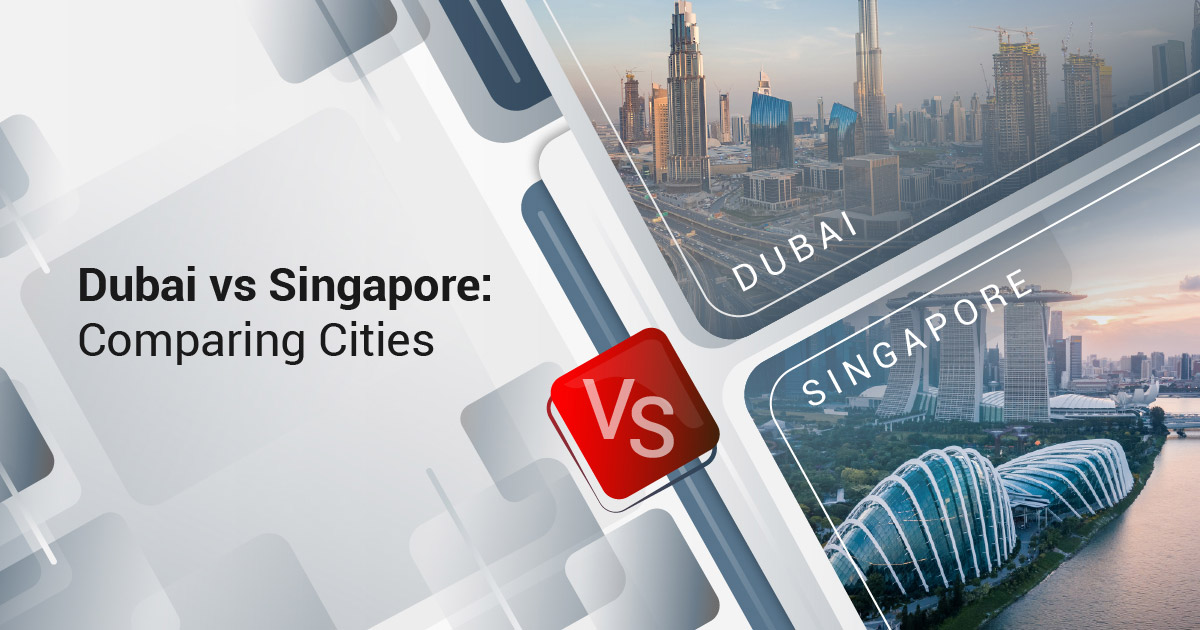
Choosing between Singapore and Dubai as your regional headquarters means picking the foundation for everything that follows – profit repatriation, contract enforcement, talent recruitment, and capital access.
Both cities have spent billions marketing themselves as business hubs. Dubai offers 0-9% tax rates and free zone incorporation in under a week. Singapore provides approximately 100+ double taxation treaties and courts with 84.2% contract enforcement rates versus Dubai’s 75.9%. The differences appear in legal certainty, tax treaty depth, and operational timelines.
Judicial efficiency scores translate directly to dispute resolution timelines. Tax rate differentials matter less than treaty networks when repatriating profits from Indonesian or Vietnamese subsidiaries. Banking access that takes days versus months affects your first month of operations, not just your tenth year.
This comparison examines legal systems, regional connectivity, fiscal realities, talent pools, and financial infrastructure across both jurisdictions.
Key Takeaways
- Choosing a regional headquarters sets the stage for critical business operations, including profit repatriation, contract enforcement, talent acquisition, and access to capital.
- Efficient legal systems and high contract enforcement rates ensure smoother dispute resolution and greater business predictability.
- Proximity to key markets and robust logistics infrastructure are essential for seamless supply chain integration and market access.
- Transparent tax structures, comprehensive double taxation treaties, and incentives for specific industries can significantly impact operational costs and profitability.
- The choice of headquarters should align with your business goals, whether focused on operational certainty, cost efficiency, or market expansion.
Legal Systems and Business Certainty
Contract Enforcement and Judicial Efficiency
Singapore’s English Common Law foundation aligns with UK and US commercial standards. Contracts drafted in London work in Singapore courts without translation across legal traditions.
Dubai operates two parallel systems. Mainland contracts follow UAE civil law rooted in Sharia and Egyptian legal codes. The Dubai International Financial Centre runs separate common law courts staffed by international judges. Businesses with assets in both zones face different enforcement rules depending on transaction location.
The Singapore International Arbitration Centre processed 625 new cases in 2024. For context, Dubai’s arbitration landscape shifted when Decree 34 abolished the Dubai International Financial Centre London Court of International Arbitration (DIFC-LCIA) centre and consolidated operations under the Dubai International Arbitration Centre (DIAC). Institutional changes during active disputes affect how arbitration clauses from previous years get interpreted.
Transparency Metrics
Singapore scores 84 on the Corruption Perceptions Index against UAE’s 68. Banking, pharmaceuticals, and defence contractors typically face enhanced due diligence requirements when operating from jurisdictions below the 75-point threshold. FCPA and UK Bribery Act compliance programmes cost more to administer when supply chains include lower-scoring markets.
Regional Connectivity and Market Access
Gateway Positioning
Singapore sits at the centre of ASEAN’s 660 million consumers, with Indonesia, Malaysia, Thailand, and Vietnam all within three hours’ flight. Dubai connects the Middle East, Africa, and South Asia through similar proximity to Gulf markets and the Indian subcontinent.
The maritime numbers, however, tell a different story. Singapore’s port handled 41.1 million twenty-foot equivalent units (TEUs) in 2023, ranking as the world’s second-busiest container port. Dubai processed 15.5 million TEUs across its facilities. That 2.65x volume gap reflects decades of supply chain integration with Asian manufacturing networks.
Aviation reverses the comparison. Dubai International Airport moved 92.3 million passengers in 2023 versus Singapore’s 67.7 million. Emirates and Flydubai operate extensive networks connecting secondary cities across the MEASA region that Singapore Airlines does not match.
Stability Considerations
Singapore maintains a AAA sovereign credit rating from all three major agencies. The city-state balances relationships with both the US and China, avoiding alignment that would compromise commercial neutrality. The UAE holds an AA rating, with regional conflicts in the Gulf periodically affecting Dubai’s risk assessment in corporate treasury models, particularly for insurance premiums and political risk coverage.
Fiscal Frameworks and Hidden Costs
Tax Structures
Dubai’s headline rate sits at 9% for mainland companies and 0% for qualifying free zone entities. The 0% rate requires substance – employees on payroll, office expenditure, and active operations within the zone. Singapore charges 17% corporate tax across all entities without jurisdictional splits.
Singapore offers various tax incentives for specified activities and industries that can lower effective corporate tax rates below the headline figure. Startups receive 75% exemption on their first S$100,000 of taxable income, with partial exemptions extending beyond that threshold.
Double Taxation Treaties
Singapore has signed approximately 100 comprehensive double taxation agreements covering major Asian economies. These treaties reduce withholding taxes on dividends, interest, and royalties flowing from subsidiaries in India, China, Indonesia, and Japan. The UAE maintains a broad treaty network, but provisions for withholding tax relief in key Asian markets typically offer less favourable rates than Singapore’s agreements.
Consumption Taxes and Fees
Dubai charges 5% VAT on goods and services. Singapore’s GST stands at 9%. Dubai businesses report substantial costs in trade licence renewals, visa processing, and sector-specific fees that function as recurring operational expenses beyond the headline tax figures.
Talent and Human Capital
Workforce Quality
Singapore’s workforce scored second on the English Proficiency Index, placing it among the highest globally for business communication. The National University of Singapore and Nanyang Technological University produce engineering and technology graduates who integrate directly into multinational operations without language barriers..
Dubai’s workforce draws from diverse expatriate populations. English serves as the business language, but technical talent depth in specialised fields like data science and advanced engineering remains thinner than Singapore’s university-fed pipeline.
Immigration Programmes for Mid-to-High-End Professionals
Singapore’s ONE Pass requires monthly fixed income of at least US$23,000, targeting C-suite executives and senior specialists. Dubai’s Golden Visa accepts monthly income from approximately US$13,600, making it accessible to mid-to-high-level professionals. Singapore curates elite talent density. Dubai prioritises volume and accessibility for a broader professional class.
Financial Infrastructure and Innovation
Banking Access
Dubai’s corporate banking presents documented delays. SMEs report waiting months to open functional accounts, facing high minimum balance requirements due to heightened AML scrutiny. Singapore banks process corporate account applications within days through digitalised onboarding. DBS, OCBC, and UOB maintain integrated platforms that allow legitimate businesses to begin operations without banking delays.
Capital Markets
Singapore ranks fourth globally on the Global Financial Centres Index (GFCI), behind New York and London. The city-state functions as Southeast Asia’s venture capital hub, supported by sovereign wealth funds Temasek and GIC. Dubai ranked 11th in the GFCI. and launched 7,800 startups in 2024 (versus Singapore’s 6,500), but funding concentrates in government-backed initiatives rather than the diverse private capital mix Singapore offers.
IP Protection
Singapore consistently places fifth in the Global Innovation Index (GII). Specialised IP courts and rigorous enforcement create protection levels comparable to Switzerland and the United States. The UAE has improved its IP framework (ranking 30th in the GII), but enforcement consistency remains below Singapore’s standards for technology and pharmaceutical sectors.
Comparing Cities
Based on the details covered above, we can summarise the key differences between these cities:
| Singapore | Dubai | |
|---|---|---|
| Legal Systems and Contract Enforcement | Singapore’s English Common Law system ensures global compatibility and high contract enforcement rates (84.2%), offering legal certainty for businesses. | Dubai operates dual legal systems, with varying enforcement rules between mainland and free zones, adding complexity for businesses with assets in both zones. |
| Regional Connectivity | Singapore excels in maritime logistics, handling 41.1 million TEUs in 2023, making it a hub for supply chain integration with Asia. | Dubai leads in aviation, moving 92.3 million passengers in 2023, connecting the Middle East, Africa, and South Asia. |
| Fiscal Frameworks | Dubai offers 0-9% corporate tax rates but includes hidden costs like licence renewals and visa fees. | Singapore’s 17% corporate tax rate is offset by tax incentives and 100+ double taxation treaties, reducing withholding taxes on profits from Asian subsidiaries. |
| Talent and Workforce Quality | Singapore boasts a highly skilled workforce with top-tier English proficiency and strong university pipelines for technical talent. | Dubai’s workforce is diverse but thinner in specialised fields like advanced engineering and data science. |
| Strategic Considerations | Singapore is better suited for businesses prioritising legal certainty, regional tax efficiency, and supply chain integration. | Dubai appeals to companies seeking lower headline tax rates and access to Middle Eastern and African markets. |
Where to Next With InCorp
Cost structures favour Dubai. Institutional frameworks favour Singapore. Your business priorities determine which matters more.
For firms building operations across Indonesia, Vietnam, Thailand, and Malaysia, Singapore’s 100+ double taxation treaties translate directly to lower withholding taxes on repatriated profits. The 84.2% contract enforcement rate means supplier disputes resolve faster. Corporate bank accounts open within days instead of months-long waits.
Dubai’s 0-9% headline tax looks compelling until you calculate total costs including licence renewals, visa processing, and banking delays. Singapore’s transparent fee structure and incentive programmes often produce comparable effective tax rates for qualifying activities.
Maritime volume also tells a compelling story – Singapore’s 41.1 million TEUs reflects genuine supply chain integration with Asian manufacturing networks that policy changes can’t replicate.
InCorp manages Singapore entity establishment for businesses entering Asian markets. We handle incorporation documentation, banking introductions, employment pass applications, and compliance filing that consumes time most companies should spend on revenue. Contact InCorp to discuss your Asia-Pacific market entry requirements.
FAQs about Dubai vs Singapore
Does Singapore's 17% corporate tax actually cost more than Dubai's rates?
- Singapore offers 75% exemption on the first S$100,000 of startup income, plus targeted incentives that reduce effective rates below headline figures. Dubai's 0% free zone rate requires substance – actual employees and office expenditure. Add Dubai's recurring licence fees and visa processing costs against Singapore's transparent fee structure for accurate comparison.
How long does corporate banking really take in Singapore vs Dubai?
- Dubai businesses consistently report multi-month delays for account approvals, with high minimum balances and extensive documentation requests. Singapore's DBS, OCBC, and UOB process applications in days through digital platforms. For cash-flow-sensitive startups, banking delays in Dubai can derail launch timelines that Singapore's streamlined process avoids.
If a supplier dispute goes to arbitration, what's the practical difference?
- Singapore International Arbitration Centre handled 1,011 cases in 2023 with established procedures under English Common Law. Dubai consolidated its arbitration centres in 2024, creating transition uncertainty for how older arbitration clauses get interpreted. Singapore's consistent framework means arbitration clauses drafted five years ago still function predictably today.
Discover how our company incorporation experts can help!
About the Author