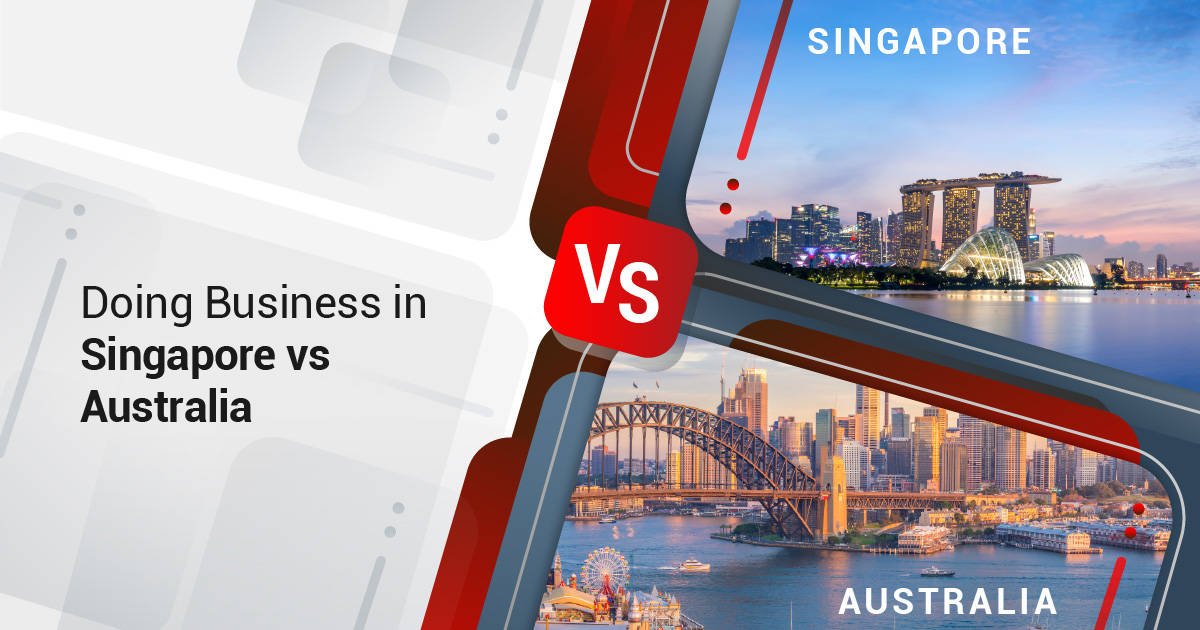
Singapore and Australia represent Asia-Pacific’s strongest business destinations, yet choosing between them grows more complex in 2026. Singapore’s flat 17% corporate tax favours profit aggregation, whilst Australia’s 25-30% rates offset higher taxes with R&D cash refunds reaching 43.5%.
The decision extends beyond headline rates: employment costs, property expenses, and compliance requirements create dramatically different operational realities that affect long-term profitability in ways most businesses discover only after commitment.
This analysis examines market entry, taxation structures, talent acquisition, property, and IP protection using IRAS, ATO, and market data. You will gain tax incentive qualifications, incorporation procedures and compliance obligations, employment cost frameworks, property market conditions, and strategic criteria determining which market aligns with holding company structures versus operational expansion.
Key Takeaways
- Singapore’s 17% flat rate rewards profit consolidation, while Australia’s 43.5% refundable R&D offset prioritises innovation funding regardless of profitability
- Singapore’s single-regulator model simplifies multi-subsidiary management, whereas Australia’s federal structure multiplies obligations across jurisdictions as your portfolio grows.
- Sydney’s 13.7% vacancy rate and 35.7% landlord incentives offer 50% lower occupancy costs than Singapore’s supply-constrained market, offsetting some tax differences.
- Singapore’s age-scaled salary thresholds (S$10,700+ at 45) price in experience, while Australia’s sector-specific National Innovation visa restricts priority access to Defense, Net Zero, Health, and Critical Minerals industries.
Market Entry: Speed vs. Complexity
Foreign investors can own 100% of private limited companies in both markets, but the similarity ends there. Singapore mandates at least one ‘ordinarily resident’ director under the Companies Act 1967.
However, starting June 9, 2025, the Corporate Service Providers Act 2024 introduces stricter controls by requiring that nominee directors used to fulfil this obligation be appointed through a registered Corporate Service Provider. Australia demands directors obtain a Director Identification Number – government-verified identity credentials stopping fraudulent company collapses.
Digital incorporation takes 15 minutes to one hour through Singapore’s BizFile+ and Australia’s online registry. The split emerges in ongoing compliance. Singapore’s single regulatory layer means straightforward annual filings. Australia’s federal structure spreads obligations across Commonwealth, state, and territory agencies.
A regional group operating five Singapore subsidiaries deals with one regulator. Five Australian subsidiaries will face multiple jurisdictions, each adding compliance hours that compound across your portfolio.
Taxation: Two Economic Philosophies
Corporate Income Tax Rates
Singapore taxes corporate income at a flat 17%. Qualifying new companies receive 75% exemption on their first S$100,000 and another 50% exemption on the next S$100,000 of chargeable income for three consecutive years. All other companies get 75% exemption on the first S$10,000, then 50% on the next S$190,000.
Australia splits companies into two categories. Small and medium businesses with turnover under A$50 million and less than 80% passive income pay 25%. Everyone else pays 30%. The passive income test catches holding companies, investment vehicles, and property trusts at the higher rate. An Australian holding company earning A$500,000 from dividends pays A$150,000 – double Singapore’s burden.
Australia classifies companies into two tiers. Base rate entities with an aggregated turnover under A$50 million and no more than 80% passive income are taxed at 25%, while all other companies pay the standard 30% company tax rate.
This passive income test often subjects investment vehicles and property trusts to the higher rate; consequently, an Australian company earning A$500,000 solely from passive sources pays A$150,000 in tax – more than double the liability of a comparable Singaporean entity.
Consumption Tax
Consumption taxes run 9% in Singapore versus 10% in Australia, though Australia exempts basic food, education, and healthcare. Singapore’s broader base simplifies compliance. Political debates in Australia propose raising GST to 15%, adding uncertainty to long-term cost planning.
Strategic Incentives
The incentive structures reveal deeper philosophical splits. Singapore’s Economic Development Board negotiates Pioneer Certificates granting 0% tax for 5-15 years for advanced technology ventures. Development and Expansion Incentives drop rates to 5-15% for regional headquarters functions, extendable to 40 years.
Australia takes an entitlement approach: companies under A$20 million turnover claiming R&D expenses receive 43.5% refundable tax offsets – cash injections supporting innovation regardless of profitability. Larger companies get non-refundable offsets scaled to R&D intensity. From July 2025, gambling and tobacco ventures lost R&D benefits entirely.
Talent Acquisition: Quality vs. Targeted Skills
Immigration Frameworks
Singapore filters foreign professionals through salary thresholds that escalate with age. General sectors require S$5,600 monthly minimum, financial services S$6,200. A 45-year-old candidate needs S$10,700, nearly double the base threshold. The government explicitly prices experience into visa eligibility.
Elite talent gets different treatment. The ONE Pass demands S$30,000 monthly earnings but offers five-year validity and permission to work multiple jobs concurrently. This targets executives shuttling between regional roles.
Australia rebuilt immigration around national priorities. The National Innovation visa focuses exclusively on Defense, Net Zero, Health, and Critical Minerals, while other sectors face tougher paths. Standard sponsorship requires A$76,515 minimum as of mid-2025. High-skill pathways expect salaries near A$183,100.
Wage Floors & Social Security
Australia’s A$24.95 hourly minimum applies to everyone – citizens, permanent residents, temporary workers. Singapore does not have a minimum wage requirement, instead choosing to use the Progressive Wage Model (PWM).
Social security costs split sharply. Australian employers pay 12% superannuation on all wages, including temporary visa holders. Singapore’s Central Provident Fund (CPF) charges up to 17% (depending on age) for citizens and permanent residents but nothing for foreign workers.
Commercial Real Estate: Divergent Markets
Singapore CBD Office Market
Grade A CBD rents reached S$11.83 per square foot monthly in late 2024 – approximately S$1,528 per square metre annually. Vacancy hovers at 11.1%. Tight supply drives the market. The IOI Central Boulevard Towers added new space but arrived 80% pre-committed, doing little to ease pressure. JLL forecasts 3.8% rental growth through 2025. Return-to-office momentum stays stronger in Asia than Western markets, keeping occupancy high.
Sydney CBD Office Market
Sydney, Australia’s most popular business hub, offers the opposite conditions. Premium net effective rents average A$890 per square metre annually after incentives in mid-2025, though gross face rents reach A$1,470. Landlords offer 35.7% incentives – rent-free periods, fitout contributions.
Vacancy sits at 13.7%, giving tenants substantial negotiating power. A company needing 500 square metres pays roughly S$71,000 annually in Singapore versus A$37,000 in Sydney after incentives – nearly half the occupancy cost.
Intellectual Property Protection
Both countries adhere to TRIPS standards but differ in cost and speed. Australia offers lower filing costs. Singapore delivers speed – patents granted in 2-4 years, or months with acceleration. Technology companies seeking rapid valuation uplift from patent portfolios find Singapore’s efficiency worth the premium. Manufacturers prioritising cost over speed favour Australia’s accessible entry points.
At a Glance
| Category | Singapore | Australia |
|---|---|---|
| Corporate Tax Rate | 17% flat rate |
|
| Consumption Tax (GST/VAT) | 9% | 10% (with exemptions for food, education and healthcare |
| Foreign Ownership | 100% allowed | 100% allowed |
| Director Requirements | Minimum 1 ordinarily resident director (via registered CSP) | Director Identification Number required |
| Time to Incorporate | 1-3 business days | 15 minutes – 1 hour |
| Regulatory Complexity | Single regulatory layer | Federal structure (Commonwealth, state, territory) |
| Strategic Tax Incentives |
|
|
| Immigration – Minimum Salary |
|
|
| Elite Visa | ONE Pass: S$30,000/month | National Innovation visa (priority sectors only) |
| Minimum Wage | No minimum wage, uses the Progressive Wage Model (PWM) | A$24.95/hour (universal) |
| Social Security |
|
12% superannuation (all workers including visa holders) |
| CBD Office Rental Cost | S$11.83/sq ft/month (~S$1,528/sq m/year) |
|
| Office Vacancy Rate | 11.1% | 13.7% (Sydney) |
| Landlord Incentives | Minimal (tight market) | 35.7% average (rent-free periods, fitout contributions) |
| Office Cost (based on 500sqm) | ~S$71,000/year | ~S$37,000/year (after incentives) |
| Patent Grant Timeline | 2-4 years (or months with acceleration) | Longer timeline |
| IP Strategy | Speed-focused (rapid valuation) | Cost-focused (accessible entry) |
Where to Next With InCorp
Singapore suits companies prioritising tax-efficient profit aggregation through its 17% flat rate. Australia serves businesses requiring operational scale – the 43.5% refundable R&D offset injects cash into product development, whilst the domestic market justifies higher compliance costs.
No universal formula exists. Technology startups building IP benefit from Singapore’s rapid patent processing. Renewable energy manufacturers need Australia’s R&D cash refunds. Many successful strategies use both – Singapore for tax efficiency, Australia for innovation funding.
InCorp maintains established operations in both markets, providing incorporation services, compliance management, and strategic structuring. Our local teams understand practical realities – from director residency requirements to R&D documentation standards.
We have guided companies through market entry decisions, helping structure operations across both jurisdictions when appropriate. Contact InCorp today to determine which jurisdiction aligns with your business model.
FAQs about Singapore vs Australia
What are the main tax differences between Singapore and Australia for businesses?
- Singapore charges a flat 17% corporate tax with substantial exemptions reducing effective rates below 15% for most companies. Australia uses a bifurcated system: 25% for small/medium businesses under A$50 million turnover with less than 80% passive income, and 30% for everyone else. The passive income test means holding companies and investment vehicles typically pay the higher 30% rate in Australia versus Singapore's consistent 17%.
How much does it cost to incorporate a company in Singapore versus Australia?
- Government incorporation fees differ significantly between jurisdictions, with ongoing annual compliance costs varying substantially. Both countries offer rapid digital incorporation processes typically completed within 15 minutes to one hour. Australia's federal structure creates layered compliance obligations across Commonwealth, state, and territory agencies, whilst Singapore's unitary system provides straightforward annual filing requirements through a single regulator.
How do commercial property costs compare between Singapore and Australia?
- Singapore CBD Grade A office space costs approximately S$11.83 per square foot monthly (S$1,528 per square metre annually) with vacancy at 4.7%. Sydney offers lower net effective rents averaging A$890 per square metre annually after 35.7% landlord incentives, despite gross face rents reaching A$1,470. Vacancy sits at 13.7%, giving tenants substantial negotiating power. A 500 square metre office costs roughly S$71,000 annually in Singapore versus A$37,000 in Sydney after incentives – nearly half the occupancy cost.
Find out how you can use GoBusiness Licensing for a seamless experience!
About the Author